Краткий гид по русской психологии A brief guide to the Russian psyche
8 августа 2014Angry Russians, Политика, Россия29 минут чтения
The collapse of the American designed and built Iraq, the American intervention into the Ukraine sparking civil war, the collapse of Libya, the victory of the anti-American Assad in Syria, and the thousands of victims of US-backed military repression in Egypt has given rise to a reasonable conclusion: that the great American nation has a poor understanding of the world around us. In particular, it is evident that Americans believe that the rest of the world and its many peoples are exactly the same, just struggling at different stages of development. Roughly speaking; Iraq — is the same as America, it just needs developmental help and advice in order to fully achieve democracy, like throwing out its bloody dictator. Where that view led to is now well known.
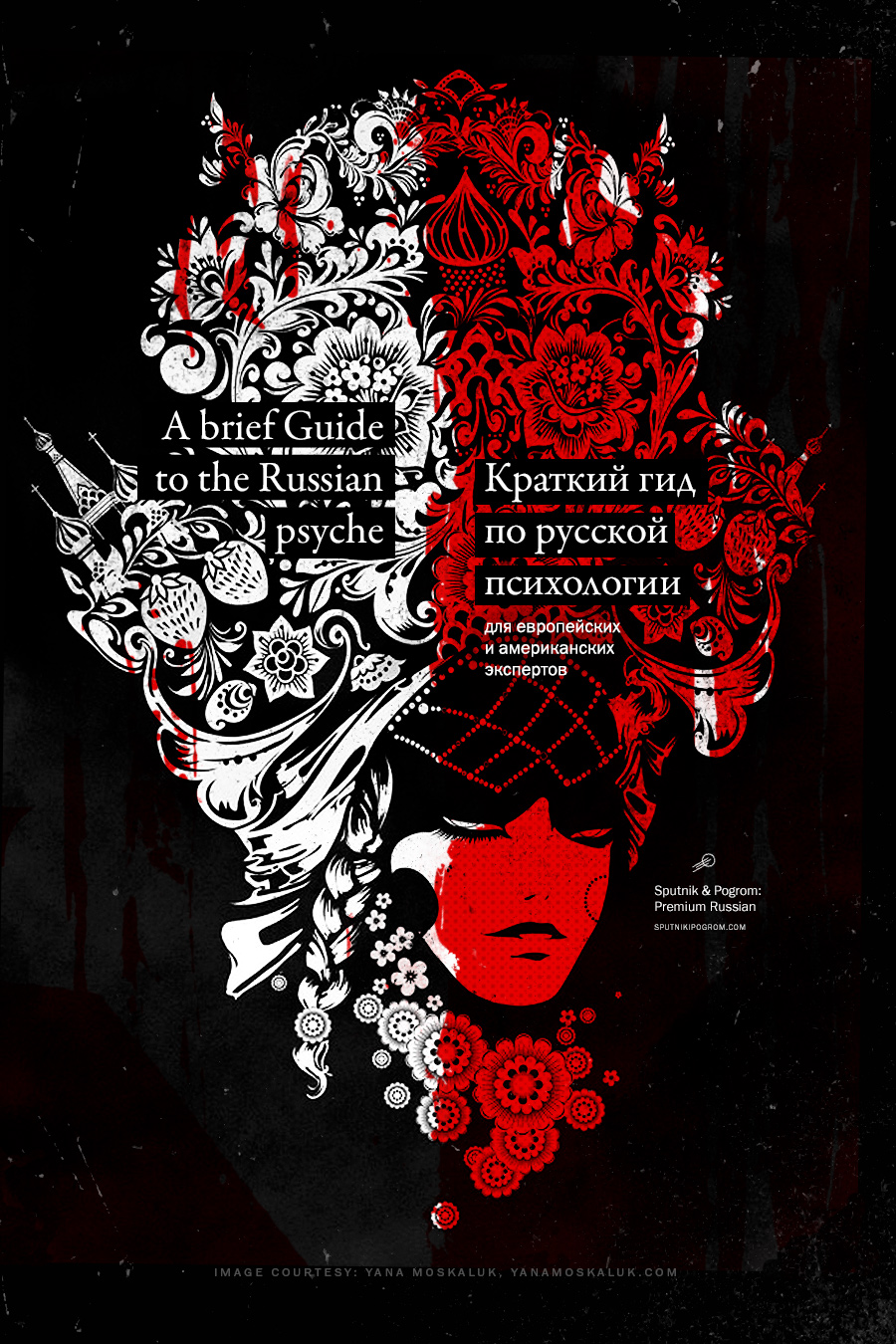
By way of a humanitarian aid gesture from the Russian intelligentsia to the American intellectual class, we have compiled this brief guide that explains the main differences between the Russian and American nations. It should be noted that most differences have remained even after 70 years of communist terror, so you can hardly expect to re-educate the Russian people (even if you use cruel, tortuous means like the Bolsheviks did). We hope that this modest work will help the good people of America see why they can’t use the same yardstick equally when dealing with all peoples and all countries.
The basic values of American society are “freedom” and “democracy.” The basic values of Russian society are the interactive understanding of “truth” and “justice.” In Russian “truth” implies not only the truth (truth — veritas), but also a form of moral superiority. I would also say that in the Russian lexicon “truth” is a hybrid between “truth” and “God’s blessing.” The one who is right is always victorious. Commitment to the concept of “truth” and “justice” gives birth to legal nihilism in Russia and its outright contempt for the international political system, if, in the opinion of Russians, if there is no “truth” behind decisions taken (even if legally such decisions are impeccably garbed). Appeals to “freedom”, “democracy”, “the right of nations to self-determination”, etc., which are self-evident to most Americans, when presented to a Russian who will view it as a verbal ploy designed to hide the absence of “truth”.
For any meaningful contact with Russian society Americans should abandon legalistic, liberating rhetoric, and instead try to explain their position in terms of truth and justice. Otherwise, Russians will view such statements made by the United States as flippant, lightweight, even comic communications.
An important component in the American consciousness is the cult of financial success and material prosperity. Russian society has evolved over the centuries as a classic military-aristocratic Empire where the businessman was, by definition, a second class citizen. Then later — as a proletarian communist state where private property was virtually abolished. Even after the blossoming of cowboy capitalism in Russia, financial motivation as a driving factor is still considered something shameful, “he’s doing it for the money” — an insult, “he did it from the heart” — the best compliment. For example, by emphasizing financial sanctions and economic losses due to the Ukrainian crisis, the United States simply insulted the Russian people collectively, assuming that our interest in the Ukraine is not “from the heart”. Public discussion by Ukrainians of the tangible benefits of EU membership makes the Ukrainians in our eyes second-class citizens. As well as their evident joy in receiving the gifts of European and American financial assistance.
American society proclaims itself as a society based on equality (even if the Gini coefficient in the United States one of the highest in the world), Russian society is by its nature hierarchical. Even the ancient Russian princes used to constantly argue about which one among them was “older” and therefore entitled to more power and rights. There was also a system of mestnichestvo (the distribution of postings depending on the type of nobility), and then Emperor Peter the Great developed the “Table of Ranks”, which determined the seniority of civil and military officials in relation to each other. After the October Revolution, in spite of the “declaration of equality” in the USSR, a new hierarchical system was evolved, the hierarchy of the Communist Party, which encompassed everything from the individual factory director to the general secretary of the CPSU Central Committee. The peak of stylish fashion — the black “government” Volga automobile, which showed clearly that its passenger had an entree into the structures of power. After the fall of the Soviet Union all this formal hierarchy collapsed, replaced by status demonstrated through visibly ostentatious wealth. Government officials with expensive watches, is a silly concept in the United States, but in Russia it is seen that firstly this is a serious influential man, one who can decide serious matters. Remember the symbol referred to as the “Hand of the King,” which was solemnly pinned to the cloak of Tywin Lannister in the TV-series “Game of Thrones” — and those items signifying the ostentatious wealth of Russian officials are quite similar.
If American officials and functionaries want to be taken seriously by Russians, they should make the effort to look the part — well turned out, expensive and solid. Starlets in dresses bought off the rack “on sale” tells us that this is a low-ranking official with no status, sent to demonstratively insult and belittle our nation. It is something akin to how our principal national poet Pushkin reacted when he was offered to assume the noble title of “gentleman of the monarchs bedchamber”, in his opinion, it was not a serious title for a man of his age. After all that, Pushkin is still considered a democrat …
Americans view Government with mistrust. To a Russian the concept of the state and public interest has a special, almost sacred meaning. Starting with Ivan the Terrible, whose “oprichnina” destroyed the ancient boyar families, eliminating any alternative to the state and sovereign as principal character throughout our history. The concept of a “minimal government”, or “the government as a night watchman” lead Russians to remember the 1990’s, when the government withdrew from most aspects of society, leading to social collapse, rampant crime and mass impoverishment. Most Russians paradoxically identify their interests with those of the government, even if nothing good ever came from it, and they themselves work in the private sector of the economy.
For a meaningful dialogue with Russian society, you have to recognize Russia’s governmental interests and to then construct your rhetoric, for example subjects such as the Ukraine, around these interests. If we see that some things are objectively beneficial to our government (for example, the return of the Crimea), no pleas, threats, sanctions or outraged appeals about the sensitivities of Ukrainians will deter or dissuade us.
The slogan “Russians do not surrender,” is at the foundation of our worldview and attitude, demonstrating the willingness to bear any loss. During the War of 1812, our capital was taken and burnt by the French, who then waited with the earnest belief that we will give up — but we won. In World War II the entire Soviet army was destroyed in the first months by the Germans, who also waited for us to assuredly give up — but we won. During WWI, we continued to fight even after the complete collapse of the front because of the 1917 revolution, and still believe, that if it were not for the treasonous treaty of Brest-Litovsk, we would, of course eventually have won. Russia never had such a phrase like “an acknowledged loss due to the inability to continue the war” (see France, or the United States during your war of 1812 with the British) we simply do not have such an understanding as in the Treaty of Ghent signed on December 24, 1814.
A leader to our way of understanding, who can accept a “reasonable loss/failure” (as in the Khasavyurt agreement which ended the first Chechnya war), is perceived by us as a traitor, and is cursed by the entire nation. After that, sooner or later, comes the next leader to sweep away the shame of defeat (after losing the Crimean War, came the victory over the Turks in 1877, after losing to Russo-Japanese War came the Soviet invasion of Manchuria, ouster of Imperial Japanese troops and the return of the Japanese occupied Sakhalin, after losing the First World War a victorious World War II, after losing the first Chechnya War a victorious second Chechnya War). The concept of “final defeat” in our political lexicon does not exist, this is worth taking under advisement when the USA handed out medals “For victory in the Cold War,” that was a big mistake.
So when your Twitter started posting tweets on the Russian language account “Progress for Ukraine” with the hash tag # nepomernayatsena (limitless cost), we could only laugh, aware that you do not know even the basics of our national psychology. In the words of our Emperor Alexander I: “If Napoleon forces us all the way to Kamchatka, we will fight in Kamchatka!”, and here today we’re talking sanctions?
Another foundation of our world view is an absolute respect for the armed forces, officers, the reality of war, and military spending. Our very government was formed based on service, where all classes, including the peasants served the sovereign. The notorious “serfdom”, which many in America mistranslated and interpreted as slavery was developed out of the idea that the aristocrat serves his sovereign through and in the military, shedding his blood for it, and the peasants serve the sovereign, providing all for the aristocrat, shedding their sweat-labor for his mission. Later, the military-aristocratic empire became a totalitarian state, whose society as a whole also worked to support the needs of a colossal war machine. This even allowed despite their poverty for Russians to enjoy a full arms race with the United States, supplying the military with the latest technologies. When the United States tries to shift equipment and troops close to our borders we perceive this as an attempt to humiliate our army, to demonstrate superiority — this we cannot allow, and if it doesn’t stop, will in due course require an adequate response.
Negotiations with Russia can only be successful if demonstratively peaceful, any demonstration of American military power will result in mass demands to increase military spending.
Despite the collapse of two of our governments in 100 years (1917 and 1991), a significant majority of Russians remain hopeful that our country will become the world’s leading alternative. The United States considers and views Russia like Germany, Great Britain and other former, resigned-to-their-fate empires. It doesn’t realize that a “return to superpower status” is a very popular theme in domestic political discussions. Russians for the foreseeable future are not prone to be resigned to fate — so any American intervention in the post-Soviet space is perceived by us as extremely negative. Even the war in Yugoslavia, which for Americans today is already a half-forgotten adventure — whereas for us it is still very much alive and a symbol of our national humiliation, which we have not yet paid back in kind. Continuing to openly interfere in our historic sphere of influence, the United States themselves only multiply the insults directed at Europe’s largest nation, which is now ruled by a soft, lacking in initiative, and gutless Putin (why is he considered in the West to be the terrible imperialist?), clearly not thinking about what will happen when Putin leaves.
We are absolutely not a liberal country. We drank from the cup of so-called “liberalism” in the 1990’s, the years of social and economic disaster, impoverishment of the population, theft of national wealth and property, and the disastrous First Chechnya War. Liberalism could have rehabilitated itself in the wake of the street protests of 2012, but for fear of taking decisive action, the Liberals lost everything. Liberals finally destroyed their popularity nationally with their position on the Ukraine. Tellingly, America’s foreign policy followed a line of reasoning based on the assumption that after Putin the liberals would come to power and agree to everything proposed to them. This seems to us extremely … naive. All the “leading” liberal visitors received by your Embassy in Moscow are truly marginal and worthless, their popularity in this country does not exceed 5%, and they are doing everything they can it would seem to force their popularity even lower.
Unlike the United States, where the reigning popular culture was formed by films, Russia is a literature centric country in which language plays a special role, with pride for the Russian language, its written poetry and books. As Americans got their language from the English, then this kind of linguistic chauvinism is unfamiliar. When Ukrainians attack the Russian language we view that as an attack on the foundations of our national identity (if Ukrainians prohibit the Russian language, they mean to say they can live without it, if they can live without Russian, then our language must not the best in the world, if our language is not the best in the world, who are we then, and why?). Something like that would even test the patience of Americans if say, the Ukrainians adopted the Constitution of the United States, and then the Ukrainians decided to toss it away. Insufficient attention by the United States to the seething language issue in Ukraine is perceived by us as yet another slight and insult.
Another difference from Americans is that Russians are deeply immersed in Russian history. For example, for any Russian it is obvious that the south-east of Ukraine are the lands conquered by the Russian Empire, taken from nomads, and settled by Russian colonists, built up by Russian hands. It was only because of the anti-Russian, and anti-national policies of the Bolsheviks who transferred and attached these lands to Ukraine through the treasonous Belavezha Accords signed by the alcoholic Yeltsin. So when these lands revolt, it is the pro-Russian rebel population (even if it is in the minority) that in truth are struggling for justice, despite the paperwork. For Americans, only the present borders of Ukraine exist, and in principle they do not understand why these boundaries stir up such emotions, nor why Russians insist on supporting the revolt of these people.
Anti-Historicism; the United States and American foreign policy is constantly playing a cruel joke with your country (for anyone who studies the history of Iraq, it immediately becomes clear that this is a chronically unstable artificial state in which no “Federal Republic of Iraq” is possible). In this case, even if you decide to get acquainted with the history of Ukraine (well, just in case you’d like to find out whether a second Iraq is in the cards), you would refer to the writings and works of Ukrainian and Polish immigrants in the United States, which for obvious reasons will not allow you to understand the Russian point of view, further putting you in an informational dead-end. The opinions and views of immigrants in the United States (who try to pleasantly describe reality through meanings and symbols that are familiar and recognizable to Americans in their own milieu) and ignoring the realities actually happening, related by people directly “in place” can only confuse and mislead — by giving serious consideration to such second hand materials is one of the obvious weaknesses in American perception and culture.
Finally, confidence and self-assurance. The American people sincerely believe that democracy is the best form of government, that there is God, and that the United States, as Obama said, is an “indispensable nation.” Russia, after all the trials and tribulations in the cauldron of the 20th century are not certain about anything. We do not believe in democracy (as one of our politicians said: “Democracy — is government controlled by Democrats”), we are not certain about God (the most terrible war in human history, we won with an absolutely godless atheistic army under the leadership of Stalin), we are not certain about America — today’s Iraq and Ukraine are fine examples of American leadership, and even in Putin, about whom you love to write we also do not believe in (one of the main themes running through Russian culture and history — “the king is an imposter” or “the king is a double,” or even the “Tsar is a fake! ” — also a popular Russian proverb). The 20th century showed us how easily everything one held to be inviolate and sacrosanct can collapse, that the world is fundamentally unstable — but when American officials, with the missionary zeal and faces of religious fanatics tell us that the world should be and what it should not be, prompts a response in us at the very minimum — of rejection.
We believe that similar feelings are prevalent in other European nations, they are either hobbled by the self-censure of being PC, or just shy in giving voice to their thoughts.
In Russia you are dealing with a major European nation, a nation of aggressive, hierarchical, revanchist, statists, brought up on the cult of war and militaristic exploits, which does not recognize the modern world system and considers the stoic endurance of hardships and privations as a part of life. Russia also relates to American culture with the same degree of snobbery that for example, the French do. Emerging from within this nation is an “irredenta” movement you are trying to write off as simply Putin and his propaganda, trying to scare Russia with economic sanctions, hashtag # nepomernayatsena (limitless cost) and even deploying a staggering 150 soldiers to the Baltic states.
And all this against the backdrop of a crumbling Iraq which before the eyes of the world you so desperately built for these past 11 years, the former symbol of the goodness of American world order. You know what we now tell westernists? “Go tell it to Baghdad.”
I hope that my humble text will help the American people understand some of the differences between the United States and Russia, as well as allow you to see how the actions of America look from the Russian point of view.
Крах выстроенного американцами Ирака, превращение американского вмешательства на Украину в гражданскую войну, развал Ливии, победа антиамериканского Ассада в Сирии и тысячи жертв репрессий поддержанных США военных в Египте породили обоснованное предположение, что великая американская нация плохо понимает окружающий мир. В частности считается, что американцы полагают все остальные страны и народы абсолютно одинаковыми, просто находящимися на разных стадиях развития. Грубо говоря, Ирак — это такая же Америка, которой просто надо помочь доразвиться до демократии, сбросив кровавого диктатора. Что из этого выходит — известно.
В рамках гуманитарной помощи от русской интеллигенции американскому интеллектуальному классу мы составили краткий справочник, поясняющий основные различия между русской и американской нациями. Следует заметить, что большинство различий сохранились даже после 70 лет коммунистического террора, поэтому вы вряд ли можете рассчитывать перевоспитать русский народ (даже если будете жестоки, как большевики). Надеемся, этот скромный труд поможет осознать доброму американскому народу, почему нельзя подходить с одной меркой ко всем народам и странам.
Базовыми ценностями американского общества являются «свобода» и «демократия». Базовыми ценностями русского общества являются взаимосвязанные понятия «правда» и «справедливость». Причем «правда» подразумевает не только истину (truth), но и некое моральное превосходство, я бы сказал, что «правда» есть нечто среднее между «истиной» и «божьим благословением». Тот, на чьей стороне правда, всегда победит. Приверженность концепциям «правды» и «справедливости» рождается в русских правовой нигилизм и откровенное презрение к международной политической системе, если, по мнению русских, за принимаемыми в ней решениями нет правды (пусть даже юридически они оформлены безупречно). Апелляции к «свободе», «демократии», «праву наций на самоопределение» и т.п. самоочевидным для американцев концептам представляются большинству русских словесной уловкой, призванной скрыть отсутствие правды.
Для содержательного контакта с русским обществом американцам следует отказаться от легалистской и освободительной риторики, попробовав объяснить свою позицию с точки зрения правды и справедливости. В противном случае русские смотрят все заявления руководства США как юмористическую передачу.
Важную часть в американском сознании составляет культ финансового успеха и материального благополучия. Русское общество долго развивалось как классическая военно-аристократическая империя (где торговец был по определению человеком второго сорта), а после — как пролетарское коммунистическое государство, где частная собственность была практически отменена. Даже после расцвета дикого капитализма в России финансовая мотивация до сих пор считается чем-то зазорным, «он делает это ради денег» — оскорбление, «он сделал это от души» — лучшая похвала. Делая в украинском кризисе акцент на финансово-экономические потери, США просто коллективно оскорбляют русский народ, предполагая, что мы интересуемся Украиной не «от души». Публичные же украинские рассуждения о материальных выгодах вступления в ЕС делают украинцев в наших глазах людьми второго сорта. Равно как и их радость от европейской и американской финансовой помощи.
Американское общество провозглашает себя как общество равенства (пусть даже индекс социального расслоения в США один из самых высоких в мире), русское же общество по своей природе иерархично. Еще древнерусские князья спорили о том, кто из них «старше» и потому имеет больше прав, затем появилась система местничества (распределения должностей в зависимости от знатности рода), затем — «Табель о рангах» Петра I, определявшая старшинство гражданских и военных чинов по отношению друг к другу. После Октябрьской революции, несмотря на провозглашение в СССР всеобщего равенства, новой иерархической системой стала иерархия Коммунистической Партии, простиравшаяся от директора отдельного завода до генерального секретаря ЦК КПСС, а высшим шиком — черная «правительственная» Волга, показывавшая, что ее обладатель вхож во властные структуры. После падения СССР все формальные иерархии рухнули, поэтому их заменила демонстрация статуса посредством показного богатства. Госчиновник с дорогими часами, дикая для США вещь, в России в первую очередь демонстрирует, что он серьезный человек, решающий серьезные вопросы. Вспомните знак «Десницы Короля», который торжественно накалывал себе на плащ Тайвин Ланнистер в «Игре престолов», — показное богатство российских чиновников аналог этого знака.
Если вы хотите, чтобы вас в России начали воспринимать всерьез, то в своих обращениях к российской публике американские чиновники и чиновницы должны выглядеть дорого и солидно. Старлетки в платьях с распродаж воспринимаются нами как низкостатусные чиновницы, посланные для демонстративного оскорбления нашей нации. Примерно как возмутился наш главный национальный поэт Пушкин, когда ему предложили придворный титул камер-юнкера, слишком, по его мнению, несерьезный для человека его возраста. И ведь Пушкин еще считается у нас демократом…
Американцы относятся к государству с недовериeм, для русского понятие государства и государственных интересов обладает особым, почти священным значением. Начиная с Ивана Грозного, чья опричнина уничтожила древние боярские роды, подрубив всякую альтернативу государству и государю, государство является основным актором в нашей истории. Концепции «минимального государства», «государства как ночного сторожа» вызывают среди русских воспоминания о 90-ых годах, когда уход государства из большинства сторон жизни общества привел к социальному коллапсу, разгулу криминала и массовой нищете. Большинство русских парадоксальным образом отождествляют свои интересы с интересами государства, даже если никогда ничего хорошего от него не видели и вообще работают в частном секторе экономики.
Для содержательного диалога с русским обществом вы должны признать государственные интересы России и выстраивать свою риторику по той же Украине вокруг этих интересов. Если мы видим, что некоторые вещи объективно выгодны нашей государственности (например, возвращение Крыма), то никакие заплачки и апелляции к оскорбленным чувствам украинцев нас не переубедят.
Слоган «Русские не сдаются» является одной из основ нашего мироощущения, демонстрацией готовности нести любые потери. В Отечественную войну 1812 года наша столица была взята и сожжена французами, всерьез ждавшими, что мы сдадимся после этого, но мы выиграли. Во Вторую мировую вся советская армия была уничтожена в первые месяцы немцами, которые ожидали сдачи после этого, но мы выиграли. В Первую мировую мы продолжали сражаться даже после полного развала фронта из-за революции, и до сих пор считаем, что если бы не предательский Брест-Литовский мир, то мы бы, конечно, выиграли. Такого понятия, как «разумное поражение вследствие невозможности продолжать войну» (см. Францию или США во время вашей войны 1812 года), для нас просто не существует. Лидер, заключающий «разумное поражение» (например, Хасавюртовский договор, закончивший Первую Чеченскую), воспринимается нами как предатель, проклинаемый всей нацией. После чего рано или поздно приходит следующий лидер, смывающий позор поражения (после проигрыша Крымской войны — победоносная Русско-турецкая 1877 года, после проигрыша Русско-японской — вторжение СССР в Манчжурию и возвращение отданного японцам Сахалина, после проигранной Первой мировой — победоносная Вторая мировая, после проигранной Первой Чеченской — победоносная Вторая Чеченская). Понятия «окончательное поражение» в нашем политическом дискурсе просто не существует — США очень зря начали раздавать медали «За победу в Холодной войне», это большая ошибка.
Поэтому когда ваш русскоязычный твиттер «Прогресс для Украины» постит твиты с хэштегом #непомернаяцена, то мы просто хохочем, понимая, что вы не знаете даже основ нашей национальной психологии. Как говорил император Александр I: «Если Наполеон отбросит нас до Камчатки, то мы будем воевать и на Камчатке!», а тут всего лишь какие-то санкции.
Другая основа нашего мировоззрения — абсолютное уважение к армии, офицерам, войне и военным расходам. Само наше государство образовалось как государство служилое, где все сословия, включая крестьян, служат государю. Пресловутое «крепостное право», которое у вас неверно толкуют как рабство, было лишь развитием идеи, что аристократ служит государю на военной службе, проливая за него кровь, а крестьяне служат государю, обеспечивая всем воюющего аристократа, проливая в своем служении пот. Позднее на смену военно-аристократической империи пришло тоталитарное государство, где также все общество работало на нужды колоссальной военной машины, что позволяло при нищете гражданского населения вести полноценную гонку вооружений с США, снабжая армию по последнему слову техники. Попытки США перебрасывать технику и солдат к нашим границам мы воспринимаем как попытку унизить нашу армию, продемонстрировать превосходство — и потому не останавливаемся, а, наоборот, требуем адекватного ответа.
Переговоры с Россией можно вести только при демонстративной миролюбивости, любая демонстрация американской военной мощи обернется лишь массовыми требованиями повысить военные расходы.
Несмотря на два крушения нашей государственности за 100 лет (1917 и 1991), значительная часть русских по-прежнему надеется, что наша страна станет альтернативным мировым лидером. США рассматривают Россию как такую Германию, Великобританию или другие бывшие и смирившиеся со своей судьбой империи, не понимая, что «возвращение статуса сверхдержавы» — сверхпопулярная концепция во внутреннем политическом дискурсе. Русские не смирились и, очевидно, в обозримом будущем не смирятся со своей судьбой, поэтому любое американское вмешательство на постсоветском пространстве воспринимается нами крайне болезненно. Даже война в Югославии для американцев — уже полузабытая операция, тогда как для нас это по-прежнему живой и актуальный символ унижения нашей нации, за который мы так и не рассчитались. Продолжая открыто вмешиваться в нашу бывшую сферу влияния, США лишь умножают счет обид и претензий со стороны самого большого европейского народа в мире, которым сейчас правит мягкий, безынициативный и безвольный Путин (почему-то считающийся на Западе страшным империалистом), очевидно, не думая, что будет, когда Путин уйдет.
Мы абсолютно нелиберальная страна, поскольку хлебнули т.н. «либерализма» в 90-ые годы, годы социальной и экономической катастрофы, обнищания населения, разворовывания советской собственности и позорной Первой Чеченской войны. Либерализм мог реабилитировать себя на волне протестов в 2012 году, но, боясь решительных действий, либералы все проиграли, окончательно уничтожив свою популярность внутри страны позицией по украинскому вопросу. Поэтому американская внешняя политика, проводимая в явном расчете на то, что после Путина к власти придут российские либералы, которые всё спишут, представляется нам крайне… наивной. Все посетители вашего посольства в Москве — заведомо ничтожные люди, чья популярность в стране не превышает и 5%, причем они делают все возможное, чтобы их популярность упала еще ниже.
В отличие от США, чья массовая культура была сформирована кино, Россия является литературоцентричной страной, в которой особую роль играет гордость за уникальный русский язык и написанные этим языком стихи и романы. Поскольку американцы получили свой язык от англичан, то этот вид лингвистического шовинизма вам малознаком. Атаки украинцев на русский язык мы воспринимаем как атаки на основы нашей национальной идентичности (если украинцы запрещают русский язык, значит, они могут без него прожить, если они могут прожить без русского, значит, наш язык не самый лучший в мире, если наш язык не самый лучший в мире, то кто мы тогда и зачем?). Что-то подобное испытали бы американцы, если бы на Украине была принята Конституция США, а потом украинцы решили бы от нее отказаться. Недостаточное внимание США к языковому вопросу на Украине воспринимается нами как еще одно оскорбление.
Еще одним отличием от американцев является глубокая погруженность русских в историю. Например, для русских очевидно, что юго-восток Украины — это земли, отвоеванные Российской Империей у кочевников, заселенные русскими колонистами, поднятые русским трудом и лишь из-за антирусской политики большевиков переданные Украине и зафиксированные на Украине предательскими Беловежскими соглашениями, подписанными алкоголиком Ельциным. Поэтому когда на этих землях восстает прорусское население (пусть даже оно в меньшинстве), мы знаем, что за ними правда и они борются за справедливость, несмотря на все ничтожные бумажки. Для американцев же существуют только современные границы Украины, и они в принципе не понимают, почему в этих границах происходят какие-то волнения и почему русские требуют ввести в поддержку этих волнений войска.
Антиисторизм США и американской внешней политики постоянно играет с вашей страной злую шутку (так, любому, изучившему историю Ирака, мгновенно становится понятно, что это хронически нестабильное искусственное государство, в котором никакая «федеративная республика Ирак» невозможна). При этом даже если вы решите ознакомиться с историей Украины (ну, просто чтоб хотя бы постфактум выяснить, не второй ли перед вами Ирак), вы обратитесь к трудам украинских и польских эмигрантов в США, которые по понятным причинам не дадут вам понять точку зрения русских, еще больше поставив вас в тупик. Предпочтение мнения эмигрантов в США (пытающихся описывать реальность в приятной для американцев системе смыслов и символов) непонятным и неприятным «трудам с мест» — одна из очевидных слабостей американской культуры.
Наконец, уверенность и самоуверенность. Добрый американский народ искренне уверен, что демократия — лучшая форма правления, что Бог — есть и что США, как сказал Обама, — «незаменимая нация». Русские после всех испытаний и потрясений железного XX века не уверены уже ни в чем. Мы не уверены в демократии (как сформулировал один из наших политиков: «Демократия — это власть демократов»), мы не уверены в Боге (самую страшную войну в истории человечества мы выиграли в абсолютно безбожной армии под лидерством безбожника Сталина), мы не уверены в Америке: сегодняшние Ирак и Украина — прекрасные примеры американского лидерства, и даже в Путине, про которого вы так любите писать, мы тоже не уверены (один из главных сюжетов русской культуры и истории — «царь-самозванец», или «подменный царь», крик «Царь-то ненастоящий!» — популярная русская поговорка). XX век показал нам, как легко может обрушиться все, что еще вчера считалось незыблемым, что мир фундаментально непрочен, а потому американские чиновники, с застывшими лицами религиозных фанатиков рассказывающие, что миру надо и чего не надо, вызывают у нас как минимум… неприятие.
Полагаем, что подобные чувства испытывают и другие европейские народы, просто стесняются их высказать.
В лице русских вы имеете дело с крупнейшей европейской нацией, нацией агрессивной, иерархичной, реваншистской, этатистской, воспитанной на культе войны и военных подвигов, не признающей современную мировую систему и считающей необходимость переносить тяготы и лишения само собой разумеющейся. А кроме того, относящейся к американской культуре с той же степенью снобизма, что к ней относятся, например, французы. Возникшее внутри этой нации ирредентистское движение вы пытаетесь списать на Путина и его пропаганду, стараясь напугать русских экономическими санкциями, хэштэгом #непомернаяцена и переброской аж 150 солдат в Прибалтику.
И всё это на фоне рушащегося на глазах всего мира Ирака, который вы так отчаянно строили последние 11 лет, бывшего символом благости американского мирового порядка. Знаете, что у нас теперь всем западникам говорят? «Ты это иди в Багдаде рассказывай».
Надеюсь, что мой скромный текст поможет великому американскому народу понять некоторые различия между США и Россией, а также позволит увидеть, как действия великого американского народа выглядят со стороны русских.
Похожие материалы
- The End of Russian History1 июня 2014
- War of Attrition: why Putin's meeting with Poroshenko won’t achieve a thing.21 августа 2014
- Русский фашистский царь30 апреля 2012
- Кого же расстрелял Сталин?5 мая 2012